
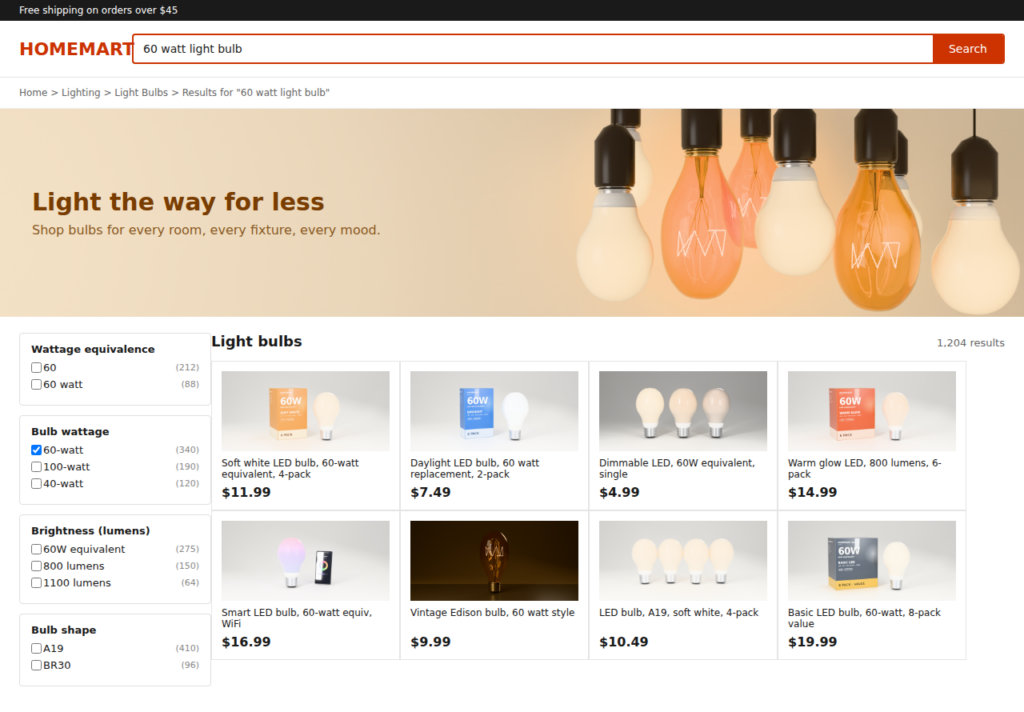
Something is afoot in the world of User Experience right now, and it’s not good. It’s become readily apparent that the U in UI/UX is being cast aside. I’m seeing it constantly. So many updated mobile apps now feature core navigation that’s been segmented and hidden behind incoherent icons scattered across the screen where users don’t expect to find them. Ecommerce sites are concealing filtering facets in overlays that close when a user clicks a single item. Just the other day, I was looking for light bulbs on a huge international retailer’s website, and they listed 60-watt equivalent filters in 3 different ways: 60, 60 watt, and 60-watt. None of these shipped by accident.
In today’s AI-driven speed-to-ship culture, it’s obvious no one is testing with real users actually using their applications. Just because something functions as expected doesn’t mean it works.
Up until recently, designing a user interface was a real production skill. The person needed to understand the psychology behind interfaces. Frontend developers knew how to consistently provide feedback that alerted users that something was received as intended or required attention. Decades of user testing led to best practices. Features were tested from the perspective of a user who needed to use the product regularly.
Figma changed that. It removed the gatekeeping that once enforced rigor. Now, anyone can drag components into a screen that looks finished in an afternoon. But looking finished and being usable were never the same thing. Figma just made it a lot easier to confuse one for the other.
AI has made things worse by an order of magnitude.
Prompt-to-prototype tools can generate a usable-looking interface in minutes, with no design background required. According to Figma’s 2025 AI report, 24% of designers and 40% of developers are already using AI somewhere in their testing process. That sounds like progress, but it’s really the same shortcut, folded earlier into the workflow and moving faster than ever.
One UX instructor ran the experiment directly: half her class designed with AI, half with traditional Figma workflows. The AI group produced polished prototypes fast. But when it came time to test, they struggled to articulate what they were even testing for. They’d skipped the part where you’re forced to decide what matters. That decision isn’t overhead. It’s the core skill needed to do the job.
Sadly, the UX job market is poised to exacerbate the problem. UXPA’s most recent data shows 35% of organizations lost UX staff, the worst net contraction on record, worse than the aftermath of the 2008 financial crisis. That’s not a blip. But it’s not a mystery either.
A lot of what got called “UX” over the last decade was production work. Make the screen. Ship the screen. Move to the next screen. That kind of work was always going to get commoditized eventually. Figma started the process. AI is finishing it.
But the bloodletting isn’t ending there. It’s extending to the folks who have what can’t be automated: judgment. Knowing why a flow will confuse someone before your customer finds out for you. Knowing when a design “works” on a screen but fails the second a real user with real intent and real impatience gets near it. That skill was always scarce. It was also always underinvested in, but now that leadership thinks that AI is doing a great job because a screen looks finished, that underinvestment is much worse.
The ridiculous part in all of this is that the consequences are quantifiable. Customers don’t buy product when they are frustrated and leave your app. Rework after an end user has done your QA work for you is significantly more expensive than finding the issue before it was designed. Brands will suffer when they think speed to market matters more than getting it right the first time.
Product owners can define what to build. AI can generate the screen. Neither can tell you if it’s right. That still takes knowledge of how people think and testing, real testing, with people who don’t want to be nice to you.
That’s the way we work here at SCIGON, with our UX people and with TestWyze, our AI-enabled testing suite.
Oh, and that big retailer? I bought the bulbs from someone else.