
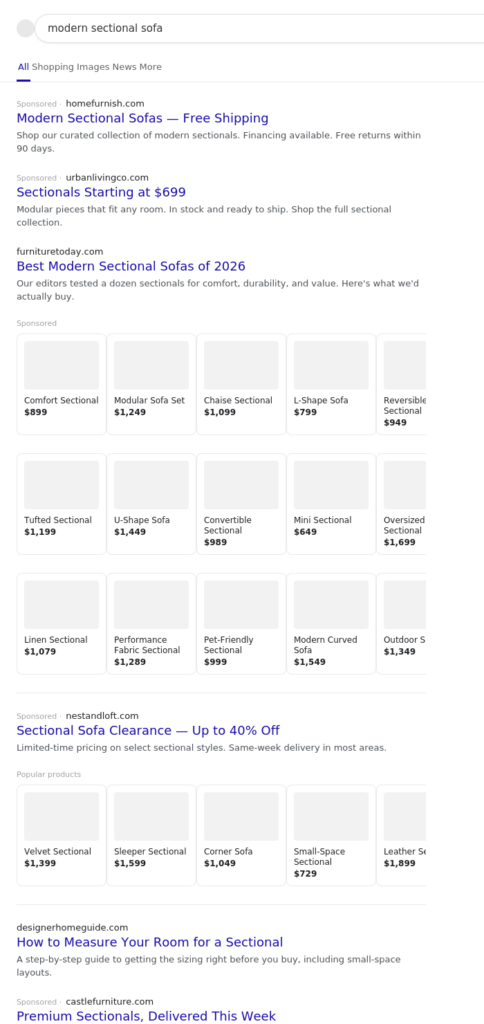
I was out shopping for a piece of furniture recently. I did some additional searching to have some intel going into different stores. Simple enough search, specific enough item. I got a whole bunch of results returned. Cool. But when I started clicking through, I realized what I got back weren’t really results at all. My phone screen was showing a results page cluttered with paid ads from retailers referencing products that they didn’t sell. Not out of stock. Not a close substitute. Just… not a thing they carry.
None of this was a glitch. It’s what happens when a company turns on “automatically generate ads from our catalog” and then never looks at what got generated.
Shopping campaigns and other automated ad formats can build ads and product listings directly from the data a retailer provides to the advertising platform. Google can use information such as product titles, descriptions, prices, and availability to determine what products to show and how to present them. Dynamic Search Ads work differently, using content from a retailer’s website to match searches and generate ad headlines. In both cases, the underlying principle is the same: automation is only as reliable as the information it is given. If that information is broad, outdated, incorrectly mapped, or poorly scoped, the system can scale the mistake just as efficiently as it scales everything else.
The reason it keeps happening is nobody owns the seam. Merchandising manages the catalog. Marketing manages the ad spend. The feed sits in between, and each side assumes the other is keeping it honest. The ad platform isn’t necessarily going to catch it. Its job is to match ads to searches and optimize performance, not to understand whether a retailer’s catalog accurately reflects what the business actually sells. A confidently wrong ad can still get a click.
But retailers aren’t the only ones at fault here. Google built the results page this way on purpose. Sponsored listings, sponsored retailer carousels, “popular products”, they’re all styled to look remarkably similar to organic results. The label that tells you an ad is an ad is small, gray, and easy to miss, especially on mobile, where I had the least room to tell the difference and the least patience to look for it. The page isn’t designed to help me find the right furniture. It’s designed to make sure I can’t easily tell an ad from an answer.
That’s not an accident either. It’s the same design logic as the retailer’s feed: whatever converts gets shown with confidence, whether or not it’s true.
Here’s what makes this worse than a bad page you stumbled onto organically: the retailer paid for this, and the platform got paid to blur the line for them. I was shown a false promise, dressed up to look like an answer, before I ever reached anyone’s site. Every mismatched ad is a rented megaphone, announcing an error to a stranger who was already reaching for their wallet. That’s not a bad look. That’s acquisition spend converted directly into distrust, at a cost per click, on a page deliberately designed to make the distrust harder to see coming.
And it compounds. Bounce rate off paid traffic. Wasted spend on ads that were never going to convert because the product was never going to be there. A customer who associates your brand with a dead end before they’ve seen a single product photo. Do that to someone on a small screen, where the ad ate half the real estate and the real answer was three scrolls away, and you’ve spent money to make someone actively annoyed at you.
The fix isn’t turning off automation. Feeds and dynamic ads exist because manually building every ad doesn’t scale, and it shouldn’t have to. The fix is putting a validation layer between what’s in the feed and what’s allowed to go live in front of a paying audience, especially on mobile, where the cost of a bad click is highest and the patience for a second try is lowest.
Nothing should get to say something to a customer on your behalf without someone checking that it’s actually true first.
Here at SCIGON, TestWyze doesn’t stop at UI. It validates the feeds and APIs behind it too, so what your systems tell a customer is actually true before you pay to say it.